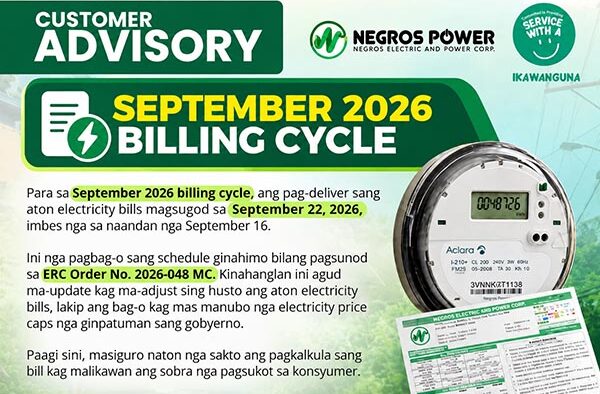

Negros Power September Rates Ease With Regional Price Cap Implementation

Electricity consumers served by Negros Power saw a slight decrease in their average residential rate this September, despite elevated prices in the Wholesale Electricity Spot Market (WESM).
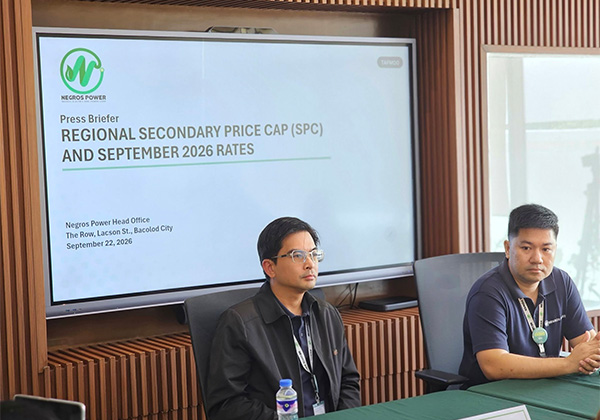
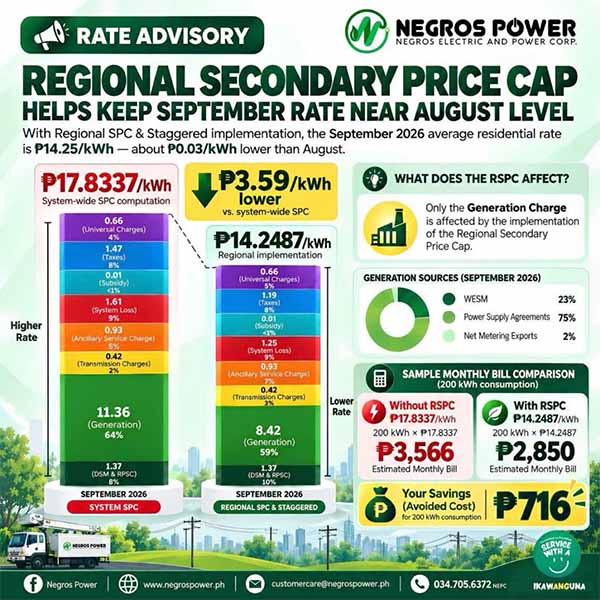
The company’s September figures show an average residential rate of ₱14.2487 per kilowatt-hour (kWh), down from ₱14.2787/kWh in August. While the difference is only ₱0.03 per kWh, the rate could have been significantly higher without measures addressing the surge in WESM prices.
What is the Regional Secondary Price Cap?
The Regional Secondary Price Cap (RSPC) is a mechanism of the Energy Regulatory Commission (ERC) intended to limit the impact of unusually high prices in the WESM.
WESM is the wholesale market where electricity is traded. When available power supply becomes tight, prices in the market can rise considerably. The regional price cap places a limit on the price that can be considered when these market costs reach exceptionally high levels.
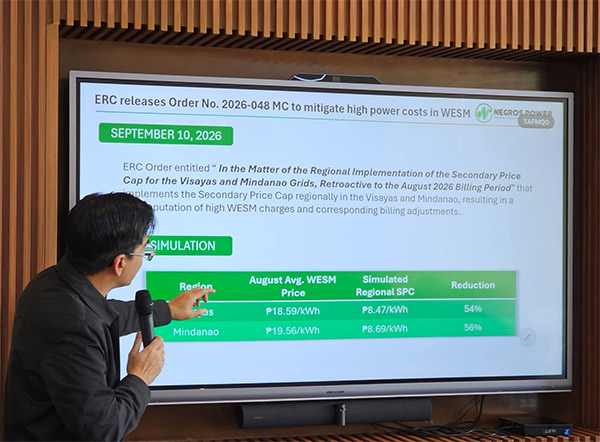
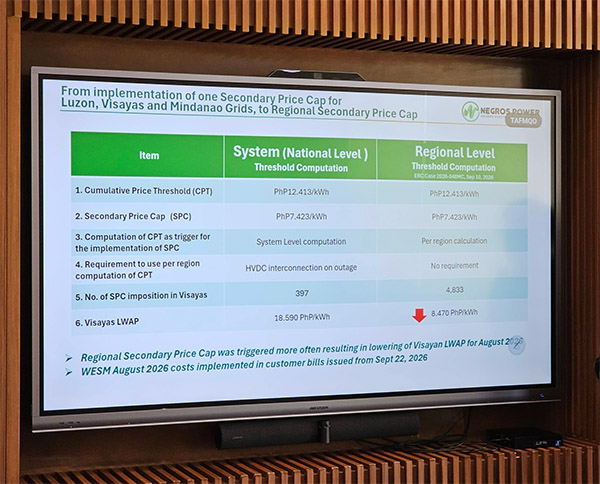
Under ERC Order No. 2026-048 MC, issued on September 10, 2026, the Secondary Price Cap was implemented separately for the Visayas and Mindanao grids, with the measure applied retroactively to the August 2026 billing period.
This regional approach is important because electricity market conditions are not always the same across Luzon, Visayas and Mindanao.
How much difference can the price cap make?
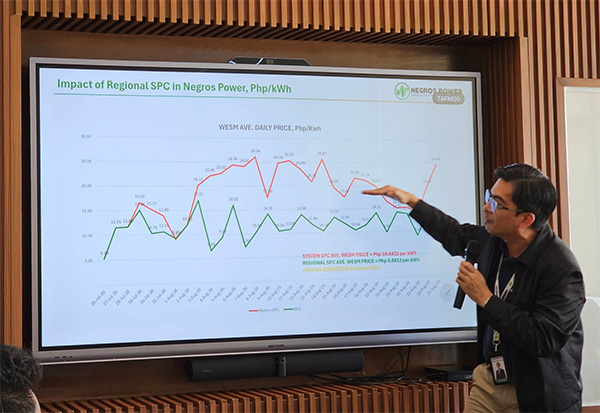
Figures presented by Negros Power Vice President and Chief Operating Officer Engr. Joe-Mel Zaporteza showed that the average WESM price in the Visayas was ₱18.59/kWh.
With the regional price cap applied, the corresponding figure in the ERC simulation was ₱8.47/kWh, representing a difference of about 54%.
This does not, however, mean that consumers will receive a 54% reduction in their total electricity bills.
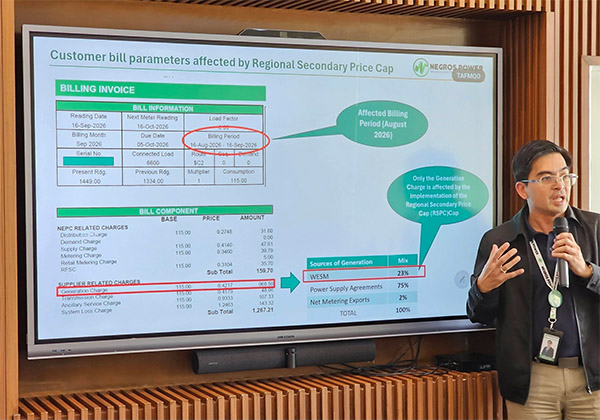
The price cap concerns the WESM component of electricity costs. For Negros Power, WESM accounts for approximately 23% of its generation sources. About 75% comes from Power Supply Agreements (PSAs), while 2% comes from net-metering exports.
As a result, the effect of the RSPC on an individual customer’s bill is only one part of the overall rate calculation.
September rate with and without the regional mechanism
Negros Power’s presentation showed how significantly the September rate could have differed under the scenarios presented.
Without the regional price cap and staggered arrangement, the average residential rate was shown at ₱17.8337/kWh. This would have been ₱3.5550/kWh higher than the August rate of ₱14.2787/kWh.
With the regional price cap and staggered arrangement, the September rate was ₱14.2487/kWh, resulting in the ₱0.0300/kWh decrease.
The generation component also changed considerably. It was shown at ₱11.36/kWh under the system-wide scenario, compared with ₱8.42/kWh under the regional price cap and staggered arrangement. The August generation charge was ₱8.48/kWh.
What does this mean for consumers?
For a household, the effect of the RSPC will depend on its electricity consumption and how the different components of the monthly rate are calculated. The 54% figure refers specifically to the simulated reduction in the Visayas WESM price, not the total residential electricity rate.
The September figures nevertheless illustrate the role of the regional mechanism in managing the effect of high spot-market prices. Rather than allowing the elevated WESM costs to push the overall residential rate toward the level shown in the system-wide scenario, the regional approach helped keep the September average close to the previous month’s rate.
For consumers, the key point is simple: the Regional Secondary Price Cap is designed to address sharp WESM price increases, but its effect on the final electricity bill is only a portion of the overall rate calculation.
The September rate figures provide a clearer picture of that impact, with Negros Power’s average residential rate ending at ₱14.2487/kWh instead of the ₱17.8337/kWh shown under the system-wide scenario.